How we picked the best weighted blanket list
Every product here is an adult weighted blanket whose maker states the blanket's weight and publishes body-weight guidance in the listing. A blanket that doesn't say who it's for isn't picked, however nice the cover looks. Kids' weighted blankets have their own page with their own rule. The table under this text shows weight, size, fill, cover and the maker's guidance as written.
A weighted blanket is a blanket filled with small beads, sewn into rows of pockets so the weight spreads evenly and can't slide to one end. Every pick on this list states glass beads as its fill. Most are 20 lb; two are 15 lb, and one is 7 lb.
The maker's chart is the rule, and charts differ
Here's the rule. Many makers suggest about 10% of body weight — check this maker's chart. That's the only general line I'll give you, and this list shows why.
Look at what the makers on this page say:
- Bare Home, 15 lb. "about 10% of your body weight", with the example that a 150 lb adult would use a 15 lb blanket.
- YnM, 15 lb. "for one person of 140lbs" and "take 10% of your body weight and add 1 pound".
- DUMOS, 20 lb. A "7%-12% body weight guideline".
- Topcee, 20 lb. "apply to 190-210 lbs body" and "8%-12% of your body weight".
- yescool, 20 lb. "10% of your body weight" and 20 lb for an adult of 190-210 lb.
- ZonLi, 20 lb. "around 8%-10%" and 20 lb for adults between 200 and 220 lb.
- Waowoo, 20 lb. "approximately 10%" of total body weight.
- Cottonblue, 7 lb. "about 10% of your body weight".
So two 15 lb blankets are pointed at two different sleepers, 140 lb and 150 lb. And three 20 lb blankets name two different ranges. None of them is wrong. They're different makers with different charts, and the chart that applies is the one that came with the blanket you buy.
My one opinion on this page, with the reason you can check above: follow the maker's chart for the blanket in your cart, not a number you read somewhere else. When the maker's chart and a general rule disagree, the maker made the blanket. (Dev put all eight charts in a spreadsheet. The spreadsheet agreed with me, which he found disappointing.)
If you want to see your number before you shop, the weighted blanket weight tool shows maker guidance labeled as maker guidance.
Size: the top of the mattress, not the floor
Weighted blankets aren't sized like comforters. They're made to cover the sleeper and the top of the mattress, so the weight stays on you instead of pulling toward the floor.
The Better Sleep Council lists a queen mattress at 60 x 80 inches. Five picks are 60 x 80 inches as listed, so they cover the top of a queen and don't hang over. Two picks are 48 x 72 inches, which their makers label twin. A twin mattress is 38 x 75 inches by the same list, so a 48 x 72 blanket is wider than a twin and a little shorter. That's normal for weighted blankets; it covers one person, not the bed.
The 7 lb Cottonblue blanket is 40 x 60 inches. That's a lap or couch size, and it's the smallest on the list.
Weight and size work as a pair. A 15 lb blanket on 48 x 72 inches puts more weight on each square inch than the same 15 lb would on 60 x 80. When you compare two blankets, read the weight and the size together, the way the maker lists them.
If you share the bed, think twice about one blanket
A weighted blanket guidance chart is written for one sleeper's body weight. Two sleepers of different weights may land on two different blankets. The 60 x 80-inch picks cover the top of a queen, but the weight is set for one person's chart.
Housekeeping rule: two sleepers, two charts. Two smaller blankets often work better than one big one, and each person can push theirs off without waking the other. The YnM listing says it plainly: one person of 140 lb.
Fill and cover: what the listings state
Fill. Every pick states glass beads. Other weighted blankets use plastic pellets or no beads at all, so it's worth reading the fill line. We show the fill only when the listing states it.
Cover. The cover fabric is what touches you. As listed:
- Cotton. Bare Home (100% cotton) and YnM (cotton).
- Microfiber. DUMOS and Topcee.
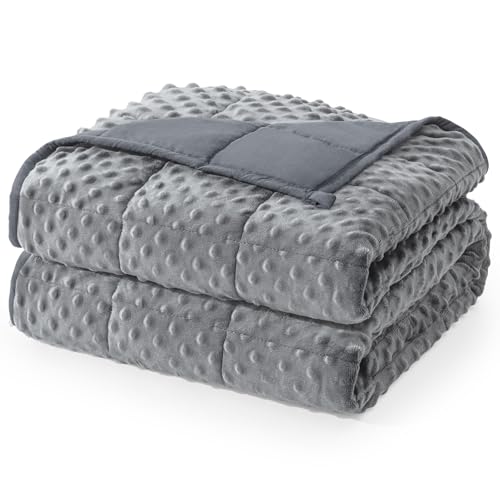
- Minky / microfiber, reversible. Cottonblue, with a dotted minky side.
- Not named in the specs. Waowoo, yescool and ZonLi, though ZonLi states OEKO-Tex certified fabric.
US labeling rules require household textiles like blankets to list fiber content by generic fiber name and percent by weight, so the tag is where you confirm what the cover is made of. If a listing's fabric words and the tag disagree, believe the tag.
OEKO-TEX. Cottonblue states OEKO-TEX certified materials; ZonLi states OEKO-Tex certified fabric. OEKO-TEX Standard 100 is a label for textiles tested for harmful substances, and each certificate number can be checked in OEKO-TEX's Label Check.
Washing a heavy blanket
First, read the care tag. A weighted blanket is the heaviest thing in the archive dry and heavier wet.
The listings we have state care for four picks:
- Cottonblue. "machine wash cold, tumble dry low".
- DUMOS. "machine wash".
- Waowoo. "machine wash", in a laundry bag on the delicate cycle.
- yescool. "machine wash".
For the others, the specs don't state a care line. That doesn't mean they can't be washed. It means you'll read the tag when it arrives, and you should before you plan around it.
Two practical checks. First, your washer: a 20 lb blanket is a lot for a small home machine, and more when soaked. Second, your dryer and your patience: beads and wet fabric dry slowly. In my hotel years we had machines the size of a small car for this kind of thing. You probably don't, and that's fine; it just means reading the tag before you buy, not after.
If the tag says spot clean only, buy a removable cover, so the cover takes the weekly wash and the heavy part doesn't.
How to choose within the list
- Find your chart. Read the maker's guidance for each blanket against the sleeper's body weight. Cross off the ones that point elsewhere.
- Pick the size. One sleeper: 48 x 72 inches. Covering the top of a queen: 60 x 80 inches. Lap or couch: the 40 x 60-inch, 7 lb blanket.
- Check washing. Every-night use means you want a care line you can live with.
- Choose the cover. Cotton, microfiber or minky, as listed.
- Then the color. Last, as always.
If two blankets fit your chart and size, the stated care line is the best tiebreaker. A blanket you can wash at home is one you'll keep using.
One more thing to picture before you order: the daily handling. You'll pull a weighted blanket up at night, push it off in the morning and straighten it when you make the bed. A 20 lb blanket doesn't drape like a comforter. It lies flat and stays where it lands. If the maker's chart gives you a choice between two weights, think about who makes the bed in your house, and how often. (In mine, it's me. Dev makes his bed on holidays and when he knows I'm coming upstairs.)
Safety: the reasons behind the standard line
The page adds the standard weighted blanket line at the end. Here's the reasoning, plainly.
Never on a baby. The American Academy of Pediatrics tells parents not to use weighted blankets, sleepers, swaddles or other weighted objects on or near a baby.
Not on a young child unless the maker states the age and weight. This list is for adults. The Cottonblue listing states "Suitable for ages 7 and up" and says it "must be used under adult supervision", but it gives no child weight range, so we don't present it as a kids' blanket. For a child, use the kids' weighted blankets page, where every pick states an age and weight range.
The sleeper must be able to remove it alone. That's the test at any age. If someone can't easily push the blanket off without help, it isn't right for them.
Follow the maker's chart. Weight guidance differs by brand, as the list above shows. Use the chart that came with the blanket.
Who should skip this whole list
- Anyone shopping for a baby or young child. Not this list, and never a baby.
- Someone who can't easily push a heavy blanket off alone. The design depends on it.
- People who sleep hot. A weighted blanket is still a blanket on top of you. Look at cooling weighted blankets, where the maker has to explain how.
- Anyone hoping a blanket will fix a health problem. It's bedding. Talk to your doctor about the problem.
- A home with a small washer and no plan for a cover. You'll feel that every wash.
If you want warmth without weight, throw blankets and comforters are simpler. If you want warmth with a plug, read best heated blankets first.
How the list is kept
The list is rebuilt from current Amazon US listings and the specs each maker states. A blanket drops off if its listing stops stating the blanket weight or the body-weight guidance, or if it stops being available. Guidance is copied as written, in the maker's own words; we don't round it, convert it or apply one maker's rule to another maker's blanket. The order follows the data, never a brand.
Nobody here has slept under, washed or weighed these blankets. The list tells you what each maker states, so you can match the chart before you match the color.
Tuck it in.