Read this first: what a pillow can and can't do
This page is general product information. It isn't medical advice, and nothing on it is a treatment for neck pain.
Neck pain has many causes. MedlinePlus, the National Library of Medicine's health site, lists muscle strain from long hours at a desk, a screen set too high or too low, poor posture while reading or watching TV, injuries and a range of medical conditions. "Sleeping in an uncomfortable position" is on that list too. A pillow can only touch that last item.
What a pillow can do is hold your head at a height and in a shape. If the height fits your sleep position, your neck can stay in line with the rest of your spine while you sleep. That's the whole job. The words "cervical", "orthopedic" and "ergonomic" on a listing name a shape or a type, not a medical result.
If your neck pain hasn't eased after a week of self-care, or comes with numbness, tingling or weakness, talk to your doctor before you shop. Our guide on how to sleep with neck pain collects what public health sources say about positions, and the signs that mean it's time to call.
The rule behind this list
I built this list on shapes and stated specs, not on promises.
- The shape is one makers design for neck support. Cervical, contour, butterfly or neck roll.
- The maker states a firmness. Firm, medium-firm or medium.
- One pillow per brand. Ten brands, ten pillows.
No pillow got in because of what its title says about pain. Several titles do use pain words, and when I mention them, I quote them as the maker's. This round, the list has no butterfly pillow. The butterfly pillows page covers the type.
The table above shows shape, fill, firmness, loft and sleep position as stated. The verdict under each pick says who it fits and who should skip it, from that pillow's specs only. No price appears anywhere; each row has a "Check price" button.
The shapes in this list
Contour, or wave, pillows
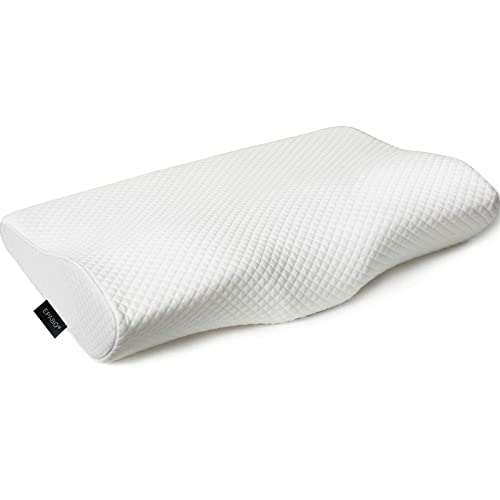
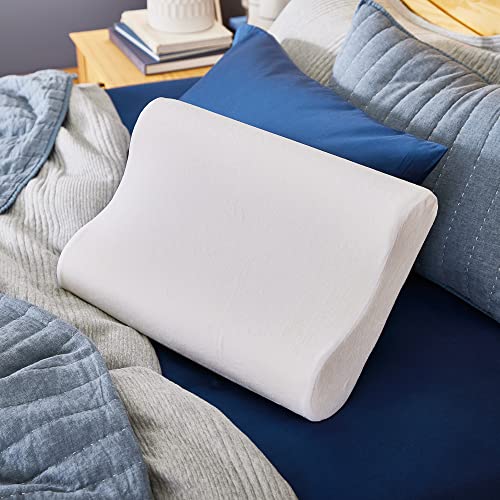
A contour pillow has a wave across it: a raised rounded edge for the neck and a lower area for the head. Seven picks are listed as contour or wave shapes. Most contour pillows have a higher and a lower edge, so you can turn the pillow to change the height. Check which edge is which before you judge the pillow. Our guide on how to use a cervical pillow walks through it.
The contour picks are the Core Products EconoWave, Epabo, HOMCA, Royal Therapy, Sleep Innovations, Sweetcrispy and Sweetnight CoolNest. See contour pillows for the whole type.
Cervical pillows with a center cradle
The C CUSHION LAB pillow is listed with a cervical shape described as a center cradle with raised edges. The head rests in the middle, and the edges rise on either side. It's firm, memory foam, and its listing names side sleepers. The RESTCLOUD pillow is sold as a cervical pillow too, but its listing doesn't state the shape in detail. See cervical pillows.
Neck rolls
A neck roll is a small cylinder that sits under the curve of your neck, usually inside or in front of a flatter pillow. The LOFE Adjustable Buckwheat Neck Pillow is the neck roll here: 17 x 6 inches, buckwheat hulls, firm, adjustable fill, an organic cotton cover and listed for back sleepers. It isn't a full head pillow. You'd use it with one. See neck roll pillows.
Neck pillow for neck pain: bed pillow or travel pillow?
People search "neck pillow" for two different things. On this page, every pick is a bed pillow or a neck roll for bed. A U-shaped travel pillow is a different product for sitting up. Harvard Health Publishing notes that a horseshoe-shaped travel pillow can support your neck and keep your head from dropping to one side if you doze while traveling or reclining, but one that's too large behind the neck pushes the head forward. Travel pillows are on our neck pillows page.
Match the pillow to how you sleep
Harvard Health Publishing names back and side sleeping as the two positions easiest on the neck. Most people move around at night. What you can choose is the position you start in and a pillow that fits it.
Back sleepers: support the curve, keep the head low
On your back, Harvard suggests a rounded pillow that supports the natural curve of the neck, with a flatter pillow cushioning the head. A contour pillow does both in one piece. A neck roll in a flat pillowcase does it in two. The Core Products EconoWave and the LOFE buckwheat roll are the two picks listed for back sleepers. A tall, stiff pillow that pushes the chin toward the chest is the thing to avoid.
Side sleepers: fill the gap to the shoulder
On your side, Harvard suggests a pillow that's higher under your neck than under your head, so your spine stays straight. The gap between your ear and your outer shoulder is the number that matters. One small study of 40 adults found the average side-lying height from the floor to the middle of the neck was 11 cm, about 4.3 inches. That's an average for that group. Broader shoulders need more.
In this list, the C CUSHION LAB is the pick listed for side sleepers. Seven others are listed for all positions. The three with a stated loft are the HOMCA at 5 inches, the Royal Therapy at 5 inches and the Sweetcrispy at 4.52 inches. If you need more height than that, the best pillows for side sleepers with neck pain is the closer list.
Stomach sleepers: the hardest position for the neck
Harvard calls stomach sleeping tough on the spine, because the back arches and the neck turns to one side for hours, and suggests starting the night on your back or side if you can. If you stay on your stomach, a shaped cervical pillow often holds the head too high. The Better Sleep Council suggests an extremely soft pillow or none, so the neck isn't at an awkward angle. That points away from this list and toward thin pillows.
How to choose within the list
Firmness: read it with the height
Five picks are firm, two are medium-firm and three are medium. Firm foam holds its shape and height. Medium gives a little more under the head. Every maker uses its own scale, so treat the word as a direction. My one opinion here, and it's checkable: the loft and firmness fields tell you more than any word in the title. "Orthopedic" doesn't have a height. A loft field does.
Adjustable or fixed
Two picks state adjustable loft. The LOFE roll lets you add or remove buckwheat. The Royal Therapy pillow adjusts from a stated 5-inch loft. A fixed memory foam pillow is what it is out of the box, apart from turning it to use the other edge. If you don't know your height yet, adjustable is the lower-risk choice.
Fill: memory foam, gel foam or buckwheat
Seven picks state memory foam, and the Sweetnight CoolNest states gel memory foam. The Core Products EconoWave doesn't state its fill. The LOFE roll is buckwheat hulls, which shift and pack around the neck and can be topped up or taken out. Memory foam holds the molded shape it came with. If you've never slept on buckwheat, our guide to buckwheat pillow benefits explains the feel and the rustle.
Size: a shaped pillow is smaller than you expect
Contour pillows usually run smaller than a standard bed pillow. The stated sizes here are 22 x 15 inches for the EconoWave, 24 x 12 x 5 for the HOMCA and 24 x 14 x 5 for the Royal Therapy. The Epabo and Royal Therapy name queen, the Sleep Innovations names standard. A shaped pillow often needs the case it came with, or one sized for it. A standard pillowcase can flatten the wave.
Claims, only as stated
Three picks state CertiPUR-US. It certifies the foam inside: made without formaldehyde, mercury, lead and other heavy metals, with low VOC emissions under 0.5 parts per million. It doesn't cover the fabric, and it isn't a health claim. Two picks state hypoallergenic, as the listing says. Two state a cooling feature and say how: a cooling cover fabric on the Sweetcrispy, gel-infused foam on the Sweetnight.
The makers' own words
Some listings in this list use health wording. Here's what the data records, quoted:
- HOMCA: "Ergonomic Memory Foam Neck Pillow for Pain Relief"
- LOFE: "Cervical Roll to Relieve Tension"
Several product names also include words like "neck pain relief". Those are the makers' descriptions of what they designed the pillow for. We haven't checked them, and we don't repeat them as our own. A pillow can't diagnose anything, and a quoted claim isn't advice.
Give a new shape a few nights
A shaped pillow feels different from a flat one, and the first night rarely tells you much. Use the edge that matches your position, give it a few nights, and notice whether you wake with your head level or tipped. If the shape doesn't suit you, that's information, not failure. Check the return terms on the listing before you open the plastic.
Read the care tag, too. The C CUSHION LAB states a machine-washable cover only; the foam itself stays out of the washer. For the others, the care tag that arrives with the pillow is the guide. A pillow protector under the case keeps a foam pillow out of the wash.
Who should skip this list
If you sleep on your stomach most of the night, a contour or cervical pillow may hold your head higher than you want. Start with thin pillows. If you like a soft, squashable pillow you can shape by hand each night, a molded foam contour will feel stiff to you. See the best pillows for softer fills.
And if your neck pain is new, sharp, follows an injury or comes with numbness, tingling or weakness, skip the shopping for now. That's a call to your doctor, not a pillow question.
How we picked
We started with every pillow in our data listed as a cervical, contour, butterfly or neck-roll pillow whose maker or listing states a firmness. We kept one pillow per brand. Specs come from the makers first, then from the listings. A field shows in the table only when one of them states it. Health wording appears only as the maker wrote it, in quotes. The data is from our late-October 2026 check.
We haven't slept on or timed any of these pillows, and we don't claim any of them helps with pain. The shapes and specs are the makers'. Before the FAQ, one more time, plainly: this is product information, not medical advice. If neck pain keeps up, talk to your doctor.