Here's the rule behind this list
Side sleeping is a height problem first. When you lie on your side, your shoulder lifts your head off the mattress, and the pillow's job is to fill that gap so your neck stays level with the rest of your spine. Harvard Health Publishing describes the side sleeper's pillow as one that's higher under the neck than under the head, to keep the spine straight.
So the rule for this list is about height:
- The maker says it suits side sleepers or all positions. Three listings name side sleepers alone. The rest say all positions.
- The maker states a loft in inches. Loft is how tall the pillow is. No number, no place on the list.
- Tallest first. The table runs from 8 inches down to about 5.5.
- One pillow per brand. Twelve brands, twelve pillows.
Here's why I ranked by height and not by fill or brand. "Supportive" never told me a number. A loft field does. It's the one spec on a pillow listing you can hold up against your own shoulder.
The verdict under each pick says who it fits and who should skip it, from that pillow's own specs. No price appears anywhere; every row has a "Check price" button.
Pillow height for side sleepers: find your number first
Before you look at the list, get a rough idea of your own gap. Here's the simplest way I know.
- Stand against a wall, shoulders relaxed.
- Have someone hold a ruler flat against your outer shoulder.
- Measure across to the side of your neck, about where a pillow would sit.
That's not a lab method, but it gives you a starting number. For a sense of scale, one small study of 40 adults found the average height from the floor to the middle of the neck, lying on the side, was 11 cm, about 4.3 inches. The shoulder rose about 4.4 cm, roughly 1.7 inches, when people turned from back to side. Those are averages for that group. Broad shoulders need more, narrow shoulders less.
Your mattress changes the answer too. A soft mattress lets your shoulder sink in, so you need a bit less pillow. A firm one keeps your shoulder high, so you need a bit more. If you're between sizes, the adjustable pillows in this list are the honest answer.
Stated loft isn't the height under your head
A pillow's listed loft is how tall it is. Once your head is on it, foam and fiber both press down some. Firm pillows press down less, soft ones more. That's why a soft 6.4-inch pillow and a firm 6-inch pillow can end up closer in height than the numbers suggest. Read loft and firmness together.
The tallest picks: 7 to 8 inches
These four suit broad shoulders, a firm mattress or anyone who has always felt their pillow was too short.
- Beckham Hotel Collection — 8 inches, the tallest stated loft here. Down alternative, medium-firm, queen, 20 x 28 inches, sold as a pair, with OEKO-TEX as stated in the listing.
- Bedsure PureWoven Adjustable Pillow — 7 inches, adjustable. Memory foam with CertiPUR-US, a cotton cover, queen.
- HOMBYS — 7 inches, firm, adjustable. Its listing names side sleepers alone and states a gel memory foam layer and a cooling fabric cover.
- Purple DreamLayer — 7 inches, medium-soft, adjustable. The stated cooling is a GelFlex Grid over a foam core.
Three of those four have adjustable loft. That's useful at the top of the range. A tall pillow that turns out to be too tall is a pillow you can fix with a zipper.
The middle: about 6 inches
This is the busiest part of the list, and the shapes vary most here.
- Tempur-Pedic TEMPUR-Cloud Dual Cooling — 6.4 inches, soft, queen, with cooling gel layers on both sides, CertiPUR-US and a washable cover. The listing doesn't state the fill, so the table leaves it blank.
- LOFE Contour Pillow — 6.1 inches, a contour shape with adjustable loft. Fill and firmness aren't stated.
- Bluewave Bedding Versalayer — 6 inches, memory foam, adjustable, king.
- Continental Bedding Side Sleeper Feather Down Pillow — 6 inches, 10% down and 90% feather, medium-firm, a 300 thread count cotton cover. The only feather and down pick.
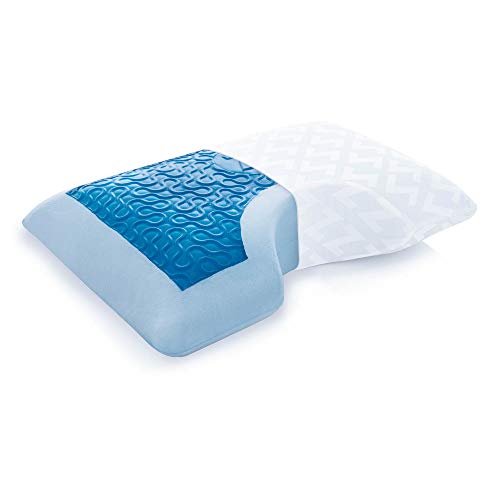
- MALOUF Z Side Sleeper Shoulder Cutout — 6 inches, memory foam, medium-firm, king at 16 x 35 inches, a liquid gel layer and a Tencel lyocell cover.
- Sealy Dreamlife — 6 inches, gel memory foam, standard size at 16 x 24 inches, a SealyChill gel layer and a washable cover.
On my morning rounds at the hotel, I could spot the side sleepers' rooms without asking. Two pillows, folded into one, wedged under where a shoulder had been. Every guest built the same tower.
The lower end: about 5.5 inches, contour shapes
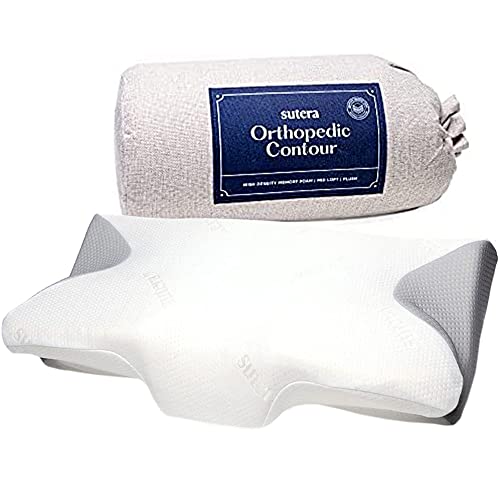
The last two picks are contour pillows, a shape with a wave: one raised edge for the neck and a lower area for the head.
- HOMCA Memory Foam Cervical Pillow — two heights, 4.7 and 5.6 inches, memory foam.
- DONAMA Cervical Pillow — 5.51 inches, memory foam.
Both listings use health words in their product names. HOMCA's says "Orthopedic Pillow for Neck Pain", and DONAMA's says "Cervical Pillow for Neck and Shoulder Pain Relief". Those are the makers' words, quoted as written. A pillow is a height and a shape. It can make it easier to keep your neck level. It can't diagnose or fix anything. If neck pain is part of why you're shopping, start with the best pillows for side sleepers with neck pain and a talk with your doctor.
These two suit narrower shoulders, a softer mattress or a side sleeper who rolls onto their back and wants a lower edge for that.
How to choose within the list
Start with height, then firmness
Match the stated loft to your shoulder number and your mattress. Then read the firmness word. If two pillows are close in height, the firmer one usually keeps more of that height through the night. Six picks don't state a firmness word at all, so the table shows a dash for them.
Adjustable loft is the safest bet if you're unsure
Five picks in this list state adjustable loft. Some use removable layers, some removable fill. Either way, you start tall and take height away. If you've never found a pillow that felt right, start here. See adjustable pillows for the whole type.
Shape: rectangle, contour or shoulder cutout
Most picks are ordinary rectangles. Three are contour shapes. One, the MALOUF, has a shoulder cutout, a notch where your lower shoulder goes so the pillow can sit close to your neck. A cutout only works if you sleep on your side most of the night; a back sleeper ends up on the notch. For more on cutouts, see shoulder pillows and pillows with an arm hole.
Fill: foam holds a shape, fiber moves
Eight picks state memory foam or gel memory foam. Foam holds its height and shape. Down alternative and feather move with you, so you shape them by hand each night. The Beckham and Continental Bedding picks are the two fiber-filled choices. At the hotel, fiber pillows got a shake at every turn-down. Foam pillows just got a fresh case.
Cooling, only as the maker describes it
Five picks state a cooling feature, and the table shows it only when the maker says how: a gel layer, a gel grid, a cooling fabric. Cooling here describes materials. It isn't a temperature promise. (In a 1924 duplex in January, nobody upstairs or down has ever complained about a warm pillow.)
Size and your bed
Two picks are king size, and the MALOUF states 16 x 35 inches. On a queen or full bed, that's a lot of pillow per person. Measure your side of the bed, and buy pillowcases that name the same pillow size.
Side sleeper pillows on Amazon: what the listing can and can't tell you
Every pick here is listed on Amazon US, and the "Check price" button goes to that listing. Read it with the loft in mind. Photos make every pillow look tall, because nobody photographs a pillow with a head on it. Titles pile on words like "side sleeper" and "neck support" whether or not the specs back them up. The useful lines are the boring ones: loft in inches, firmness, fill, size and care. We haven't collected buyer reviews for these pillows yet, so this page doesn't summarize any. When we do, they'll show as general notes, never quotes.
Who should skip this list
If you sleep on your back most of the night, a tall side sleeper pillow will push your chin toward your chest. Start with the best pillows list and its back sleeper notes instead. If you sleep on your stomach, you want the opposite of this page: a soft, low pillow or a thin pillow.
And if your current pillow fills the gap, holds its height through the night and you wake without a stiff neck, you don't need a new one. Put a pillow protector on it and keep it.
Housekeeping rule: the second pillow goes between your knees, not on top of the first. The Better Sleep Council suggests one for side sleepers to ease the hips and lower back. Our knee pillow page has the shapes.
Care before you commit
Read the care tag. Two picks state a machine-washable cover: the Tempur-Pedic and the Sealy. The rest don't state care in our data, so check the tag when the pillow arrives. Foam pillows usually don't go in the washer whole. Fiber pillows often can, but check. A pillow protector under the case saves the pillow from most of the weekly wash. Our guide on how to wash pillows has the steps.
CertiPUR-US appears on two picks. It certifies the foam inside, made without formaldehyde, mercury, lead and other heavy metals, with low VOC emissions under 0.5 parts per million. It doesn't cover the fabric.
How we picked
We started with every pillow in our data whose maker or listing says it suits side sleepers, or all positions, and states a loft in inches. We ranked them by stated loft, tallest first, and kept one pillow per brand. Specs come from the makers first, then the listings. A field shows in the table only when one of them states it; a dash means neither did. The data is from our late-October 2026 check.
We haven't slept on, washed or timed any of these pillows. The heights are the makers'. Your shoulder decides which one is yours, and the pillow quiz can help if you're still guessing.